What Is Panchakarma? A Simple Guide for Patients
Say the word "Panchakarma" to ten people and you will probably get ten different answers. One person thinks of a relaxing oil massage. Another imagines a strict yearly cleanse. A third believes it is a package where every patient receives the same five treatments.
None of these ideas is quite right. Panchakarma is one of the best-known parts of Ayurveda, but it is also one of the most misunderstood. In this blog, we will clear the confusion step by step, in plain language, so you can walk into a consultation feeling informed and confident.
What Does Panchakarma Actually Mean?
The word comes from Sanskrit. Pancha means five, and karma means action or procedure. So Panchakarma simply means "five therapeutic procedures."
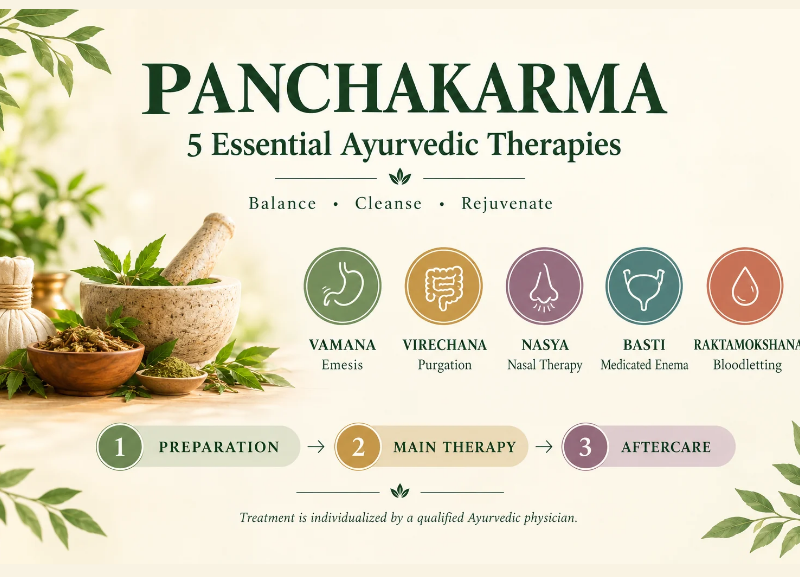
These five procedures are Vamana, Virechana, Basti, Nasya and Raktamokshana. Each one works through a different route in the body and is chosen for different situations. Some Ayurvedic traditions classify the procedures a little differently, so you may see small variations in older texts or from different physicians.
The key thing to remember is that Panchakarma is a medical process, not a single treatment. It is planned, supervised and adapted to the person receiving it.
Two Ways Ayurveda Approaches Illness
To understand where Panchakarma fits, it helps to know that Ayurveda describes two broad ways of managing a health problem.
Shamana Chikitsa (pacification therapy) aims to calm and balance the aggravated Doshas using medicines, diet, lifestyle changes and other supportive measures. Think of it as settling a disturbance gently.
Shodhana Chikitsa (purification therapy) aims to remove the aggravated Doshas from the body through specific procedures. Panchakarma belongs to this category.
Which path is suitable depends on you: your condition, your strength, your digestion and your age. For many people, Shamana alone is the right choice. Panchakarma is not necessary for every person or every disease, and a responsible physician will tell you so.
When to do Panchakarma ?
Here is an easy way to picture it. Before Diwali, most of us clean our homes properly. We clear the dust from corners, sort our belongings and get the house ready for the year ahead.
Panchakarma is traditionally understood in a similar spirit: a systematic effort to address imbalances that have built up over time. But notice something about house cleaning. A small flat does not need the same effort as a large bungalow, and a freshly painted room does not need the same attention as a neglected one.
In the same way, no two people need the same Panchakarma plan. The treatment is chosen according to your constitution (Prakriti), the Dosha imbalance, your current health, your strength, your digestive capacity and your age.
Common Myths About Panchakarma
Let us look at the misunderstandings we hear most often in the clinic.
Myth 1: Panchakarma is just a massage. Oil massage (Abhyanga) and other gentle therapies are often part of the preparation, but a massage on its own is not Panchakarma. The five principal procedures are very different from a spa session.
Myth 2: All five procedures are done together. They are not. In many cases, a physician selects just one procedure, or a suitable combination, based on what the patient needs.
Myth 3: Everyone should do Panchakarma every year. Some people like to follow a seasonal routine, but it is not a requirement for every healthy person. The decision should come from a proper assessment, not from a trend.
Myth 4: It is the same as a detox diet or juice cleanse. "Detox" is a modern word people use to explain Panchakarma quickly. In Ayurveda, Shodhana has its own framework, with assessment, preparation, a main procedure and carefully planned recovery. A juice cleanse has none of this structure.
Myth 5: It can be done at home. The major procedures should never be attempted at home without professional assessment and supervision. If done incorrectly, some of them can cause real complications.
What Makes Panchakarma Different From Other Therapies?
Three things set it apart.
First, it is individualised. Two people with similar symptoms may receive completely different plans.
Second, it is structured. A proper course has three stages: preparation, the main procedure, and recovery. We will explain these in detail in our third blog.
Third, it is supervised. A qualified Ayurvedic physician decides whether you are suitable, monitors you during treatment and guides you afterwards.
If a centre offers a one-size-fits-all package without asking about your health history, that is worth questioning.
Is Panchakarma a Cure for Everything?
No, and it is important to be honest about this. Panchakarma may be considered as part of a broader management plan for certain conditions, but its usefulness varies from one condition to another. Evidence from modern clinical research is also different for different procedures and different health problems.
Serious symptoms such as high fever, severe infection, difficulty in breathing or significant bleeding need prompt medical evaluation. They should never be treated as a reason to "try Panchakarma first."
Who Should Consider Panchakarma?
A physician may consider Panchakarma when a person has a condition where purification therapy is clinically appropriate and the person is strong enough to undergo it. Classical Ayurveda also discusses purification for suitable healthy individuals, usually in line with the seasons.
On the other hand, certain people may need to avoid specific procedures or wait until their condition improves. This is exactly why the first step is always a consultation, not a booking.
What to Expect When You Visit a Panchakarma Clinic
A good first visit usually includes a detailed conversation about your symptoms, how long you have had them, your digestion, sleep, energy levels, diet and daily routine. The physician may also examine your pulse and general condition and ask about previous treatments or medicines.
Only after this does the doctor suggest a plan. You should leave the consultation knowing which procedure is proposed, why it was chosen, what preparation is needed, and what to expect afterwards.
Final Thoughts
Panchakarma is a valuable part of Ayurvedic medicine, but it is far more than a relaxing treatment or a trendy detox. It is a carefully planned process that works best when it is matched to the right person at the right time.
At Arogyanivesh Ayurved Clinic & Panchakarma Centre, our approach is to listen to your concerns, assess your condition and then discuss the options that suit you, rather than recommending Panchakarma to everyone.
If you have questions about whether Panchakarma is right for you, book a consultation with a qualified Ayurvedic physician. Invest in understanding your health before you choose a treatment.