The Ayurveda We Follow Today: Tradition or Trend?
By Dr. Nilesh Dhavale
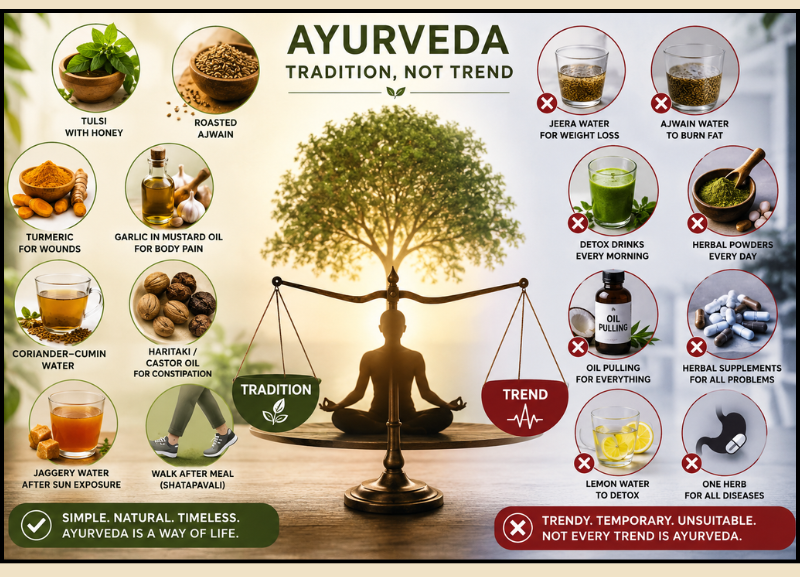
Ayurveda is often described as the “science of life.” But in today's digital world, the way Ayurveda is presented to us is changing rapidly.
Open Instagram, YouTube or Google and you will find hundreds of claims associated with Ayurveda:
- Jeera water burns belly fat.
- Ajwain water melts fat.
- Turmeric can be applied every day for glowing skin.
- Ashwagandha should be taken by everyone.
- Shatavari is essential for every woman.
- Oil pulling can cure almost every disease.
- Every herbal drink is a “detox.”
- Every natural product is automatically safe.
But how much of this is actually Ayurveda?
Or have we started creating a new version of Ayurveda based on social-media trends?
As an Ayurvedic physician, I believe this distinction is important. Ayurveda should not be reduced to a collection of viral home remedies. It has its own concepts of diagnosis, diet, lifestyle, medicinal substances and therapeutic procedures.
At the same time, traditional knowledge needs to be communicated responsibly and evaluated through appropriate scientific evidence. The World Health Organization's Global Traditional Medicine Strategy 2025–2034 emphasizes evidence, safety, quality and the responsible integration of traditional medicine into healthcare.
WHO — Global Traditional Medicine Strategy 2025–2034
What Does “Ayurvedic” Actually Mean?
One of the biggest misunderstandings today is:
“If something is natural, it must be Ayurvedic.”
That is not correct.
Ayurveda evaluates substances through concepts such as Rasa, Guna, Virya, Vipaka and Prabhava, while also considering the person's Prakriti, Vikriti, Agni, Dosha, Kala, Desha and Bala.
Therefore, the Ayurvedic question is not simply:
“Is this ingredient good?”
It is:
“Is this appropriate for this person, at this time, in this quantity and for this condition?”
This individualized approach is fundamental to understanding Ayurveda.
The Government of India's Pharmacopoeia Commission for Indian Medicine & Homoeopathy (PCIM&H) maintains official pharmacopoeial standards and monographs for Indian systems of medicine. This is particularly useful when distinguishing recognized Ayurvedic medicinal substances and formulations from products that merely use Ayurvedic terminology for marketing.
Pharmacopoeia Commission for Indian Medicine & Homoeopathy — Official Portal
1. Weight Loss, Detox and Metabolic Wellness Trends
Jeera Water for Weight Loss
The Trend
“Drink cumin water every morning and lose belly fat.”
The Ayurvedic Perspective
Jeera has an important traditional association with digestion and Agni. It may be useful in appropriate individuals with complaints such as indigestion, bloating or excessive gas.
But this does not mean that cumin water is a universal “belly-fat burner.”
Weight management is considerably more complex than drinking one particular beverage. Ayurveda considers factors such as Agni, Ahara, Vihara, Dosha and Meda.
Therefore:
Jeera water may have a place in an appropriate dietary routine, but calling it a universal weight-loss treatment oversimplifies Ayurveda.
For readers looking for authentic information about Ayurvedic medicinal substances, the Government of India's PCIM&H resources are a more appropriate starting point than social-media posts.
PCIM&H — Ayurvedic Pharmacopoeial Resources
Ajwain Water for Weight Loss
The Trend
“Ajwain water melts fat and burns belly fat naturally.”
Ajwain and related aromatic digestive substances have traditional Deepana and Pachana applications.
However, “fat burning” is not an adequate description of their classical therapeutic purpose.
A substance with warming properties may also be inappropriate for certain individuals, particularly when excessive use aggravates Pitta or acidity-related symptoms.
This illustrates an important Ayurvedic principle:
The same substance cannot automatically be prescribed to everybody in the same quantity.
Methi Water for Diabetes and Weight Loss
The Trend
“Soak fenugreek seeds overnight and drink the water to control diabetes and lose weight.”
Fenugreek has a long history of dietary and medicinal use.
However, drinking soaked methi water should not automatically be presented as a complete Ayurvedic treatment for Prameha or Madhumeha.
Diabetes requires appropriate assessment and ongoing management. Ayurvedic dietary and medicinal decisions should consider the individual's Agni, Dosha, Ahara, Meda, Bala and disease status.
For information about research in Ayurveda and other AYUSH systems, readers can also refer to the Government of India's AYUSH Research Portal, which provides access to research-related information.
AYUSH Research Portal — Government of India
Cinnamon Water as an Ayurvedic Fat Burner
Cinnamon, traditionally known as Tvak, has warming and stimulating properties.
It may have a place in appropriate dietary or therapeutic contexts, particularly when sluggish digestion and Kapha-related factors are involved.
But calling cinnamon water an “Ayurvedic fat burner” reduces a complex medical system to a marketing phrase.
Excessive use may also be unsuitable for some individuals.
Coriander Water and “Detox”
The Trend
“Drink coriander water to detox the entire body.”
Coriander, or Dhanyaka, has traditional applications and is valued in Ayurveda in appropriate digestive and Pitta-related contexts.
However, the modern wellness word “detox” is considerably broader than the classical Ayurvedic understanding of purification.
A glass of coriander water should not automatically be equated with Panchakarma.
2. Lemon Water Detox
Warm lemon water has become one of the most popular wellness rituals.
Lemon or Nimbuka has its own dietary and Ayurvedic properties. However, claims that lemon water universally:
- flushes toxins,
- melts fat,
- cleanses the liver,
- resets metabolism,
should not be presented as though they are universal classical Ayurvedic teachings.
The word “detox” is frequently doing more marketing work than medical work.
3. Is Apple Cider Vinegar Ayurvedic?
The Trend
“Apple cider vinegar is natural, therefore it must be Ayurvedic.”
Natural does not automatically mean Ayurvedic.
Ayurveda evaluates medicinal substances according to their properties, actions, preparation and suitability.
Therefore, simply combining a modern ingredient with Ayurvedic herbs does not automatically make the resulting product a classical Ayurvedic formulation.
4. “Flush Your Liver” Ayurvedic Drinks
The Trend
“Drink this Ayurvedic mixture to flush and cleanse your liver.”
Ayurveda discusses Yakrit and various disorders involving digestion and metabolism. However, the phrase “liver flush” primarily belongs to modern wellness terminology.
Ayurvedic management is based on assessment of the disease, Dosha, Agni, Dhatu and individual factors rather than assuming that everybody needs the same liver-cleansing drink.
5. Oral Health: Neem Datun vs Modern Toothbrush
Ayurveda describes Dantadhavana as part of appropriate daily routine and discusses the use of suitable plant materials for oral care.
However, this does not mean:
“Everyone should use Neem datun and modern toothbrushes are harmful.”
Traditional oral hygiene should be understood in its proper context.
The choice of material, method, frequency and individual condition all matter.
The broader Ayurvedic concept of daily routine can be explored through official AYUSH resources rather than reducing it to social-media slogans.
Ministry of Ayush — Government of India
6. Salt + Mustard Oil for Gum Health
Salt and oil-based oral practices are frequently recommended online.
Ayurveda does contain traditional approaches to oral care, but every home remedy found online is not automatically a classical Ayurvedic formulation.
Persistent gum bleeding, swelling, pain or other oral problems should receive appropriate dental assessment rather than being managed indefinitely with home remedies.
7. Clove Oil for Toothache
Clove has traditional medicinal applications and is valued for its aromatic and warming properties.
But concentrated clove essential oil is not necessarily equivalent to the traditional use of the raw drug or a properly prepared Ayurvedic formulation.
This is another example of why:
Ingredient ≠ formulation ≠ medicine.
Preparation and concentration matter.
8. Oil Pulling: Ayurveda or Modern Cure-All?
Ayurveda describes practices such as Gandusha and Kavala as part of oral care.
However, social media has expanded oil pulling into claims that it can cure:
- diabetes,
- obesity,
- acne,
- migraine,
- hormonal disorders,
- and numerous other systemic conditions.
These claims should not be confused with the classical purpose of Ayurvedic oral practices.
9. Drinking One Litre of Water Immediately After Waking
The Trend
“Drink one litre of water immediately after waking to flush toxins and lose weight.”
Ayurveda values appropriate hydration, but that does not mean that every individual should forcibly consume exactly one litre immediately after waking.
Hydration requirements vary according to factors such as:
- thirst,
- activity,
- season,
- diet,
- digestive capacity,
- and individual health status.
More water is not automatically more beneficial.
10. The Rise of “Kadha Culture”
During the COVID-19 pandemic, herbal kadhas became extremely popular.
Ginger, black pepper, cinnamon, clove and Tulsi were commonly combined in household preparations.
The ingredients themselves have traditional uses.
The problem arises when people assume that:
The more herbs you add, the stronger the medicine becomes.
That is not how classical Ayurvedic formulation works.
Ayurvedic formulations are designed according to therapeutic objectives, properties, compatibility, preparation and dosage.
For broader research and evidence relating to AYUSH practices, the Government of India's AYUSH Research Portal provides a useful resource.
11. Can Everyone Drink Kadha Every Day?
Not necessarily.
Strongly heating combinations may be unsuitable for some people and may aggravate complaints such as acidity or burning in susceptible individuals.
Ayurveda emphasizes Matra, Kala and individual suitability.
Therefore:
A kadha that is appropriate for one person is not automatically appropriate for everyone.
12. Reetha and Shikakai: Should Everyone Stop Using Shampoo?
Reetha and Shikakai have traditional applications in hair cleansing.
But the statement:
“Chemical shampoos damage hair, so everyone should use Reetha and Shikakai”
is too simplistic.
Scalp oiliness, dryness, dandruff, inflammatory conditions, hair texture and underlying scalp disease all influence the appropriate cleansing approach.
The goal should not be to blindly reject modern products.
The goal should be appropriate hair and scalp care.
13. Onion Juice for Hair Growth
Onion juice has become a viral hair-loss remedy.
But hair loss is not one single disease.
Hair fall can be associated with:
- nutritional factors,
- hormonal changes,
- genetics,
- inflammatory scalp disorders,
- autoimmune conditions,
- systemic illness,
- medications,
- stress and other factors.
Therefore:
Diagnosis should come before treatment.
A viral home remedy should not replace assessment of the actual cause of hair loss.
14. Rice Water: Ancient Ayurveda or Modern Beauty Trend?
Rice water is frequently marketed as an “ancient Ayurvedic secret.”
However, not every traditional Asian beauty practice is Ayurveda.
Ayurveda has its own extensive concepts concerning Kesha, Keshya substances, hair oils and cleansing practices.
A beauty practice becoming popular on Instagram does not automatically make it classical Ayurveda.
15. Amla for Every Type of Hair Fall
Amla or Amalaki is undoubtedly an important Ayurvedic medicinal substance with a significant place in traditional practice.
But:
Amla is not automatically the answer to every type of hair loss.
Different causes require different approaches.
The cause, Dosha involvement, scalp condition, nutrition and associated disorders must be considered.
16. Coconut Oil for Every Scalp
Coconut oil has valuable traditional applications.
But one oil cannot be considered ideal for every scalp.
An oily, inflamed, infected or severely dandruff-prone scalp may require a different approach from a dry scalp.
This is where the principle of individualized Ayurveda becomes important.
17. Aloe Vera for Every Skin Problem
Aloe-based preparations have traditional uses.
But “cooling” does not mean “suitable for every skin disease.”
Acne, eczema, fungal infection, pigmentation and inflammatory skin conditions are different clinical problems.
A soothing ingredient may feel comfortable while still being inappropriate for a particular condition.
18. Turmeric Face Pack Every Day
Turmeric or Haridra has an important place in Ayurveda.
But being an Ayurvedic substance does not mean that applying it every day is necessary for everyone.
Preparation, quantity, frequency and individual skin sensitivity matter.
19. Lemon Juice for Pigmentation
This is one of the home remedies I would strongly discourage people from following casually.
Direct application of concentrated lemon juice can irritate the skin in some individuals.
And skin irritation may itself worsen pigmentation in susceptible people.
Therefore, pigmentation should be assessed according to its underlying cause rather than simply trying to “bleach” the skin using household ingredients.
20. Ashwagandha Every Morning
Ashwagandha is an important Ayurvedic medicinal plant and has a significant place in traditional Rasayana practice.
However, the modern message:
“Everyone should take Ashwagandha every morning for stress, strength, sleep and testosterone”
is an oversimplification.
Its suitability depends upon factors such as:
- Prakriti,
- Agni,
- age,
- disease condition,
- therapeutic objective,
- formulation,
- dosage.
For official information and resources relating to Ayurveda and AYUSH systems, the Ministry of Ayush portal is a useful reference.
Ministry of Ayush — Government of India
21. Shatavari for Every Woman
Shatavari has an important place in Ayurvedic women's health and Rasayana approaches.
But:
Every woman does not automatically need Shatavari.
Women's health concerns are diverse. Menstrual problems, infertility, menopausal symptoms and other conditions require appropriate assessment rather than a universal supplement approach.
22. Triphala Gummies: Is This the Same as Classical Triphala?
Triphala is a classical combination of:
- Haritaki,
- Bibhitaki,
- Amalaki.
Modern products such as gummies may offer convenience.
However, a modern dosage form should not automatically be assumed to be identical to every classical Triphala preparation.
The ingredients, quantity, processing, dosage and intended indication matter.
This is why official pharmacopoeial and formulary resources are valuable when evaluating Ayurvedic formulations.
Pharmacopoeia Commission for Indian Medicine & Homoeopathy
23. Moringa: Is It an Ayurvedic “Superfood”?
Moringa or Shigru has a place in traditional medicine.
But the word “superfood” is primarily a modern nutrition and marketing term.
Ayurveda evaluates a substance according to its properties, effects, quantity, preparation and suitability—not simply because it has become popular online.
24. Is Shilajit Really an Ayurvedic Testosterone Booster?
Shilajit has a significant history in Ayurveda and is associated with Rasayana and Vajikarana-related applications.
Modern marketing frequently reduces this complex substance to:
“Natural testosterone booster.”
That is an oversimplification.
Traditional use, purification, formulation, dosage and patient selection all matter.
A classical medicinal substance should not be reduced to a single modern marketing claim without appropriate context.
25. “100% Ayurvedic” — What Does It Actually Mean?
The phrase “100% Ayurvedic” is now frequently used in marketing.
But it should not automatically be interpreted as:
- suitable for everyone,
- completely risk-free,
- clinically proven for every claim,
- equivalent to a classical formulation.
Consumers should look for:
- ingredients,
- formulation,
- dosage,
- intended use,
- manufacturing information,
- quality standards,
- appropriate regulatory information.
The Ministry of Ayush and PCIM&H provide official resources relevant to the Ayurvedic drug and pharmacopoeial framework in India.
26. “No Side Effects Because It Is Natural”
This is one of the most misleading ideas in modern wellness marketing.
Natural does not mean risk-free.
The important questions are:
- What is the substance?
- What is the dose?
- How is it prepared?
- Who is taking it?
- Why is it being taken?
- What other medicines are being used?
Responsible Ayurvedic practice also recognizes the importance of appropriate dosage, indication, preparation and individual assessment.
The WHO's current traditional medicine strategy similarly emphasizes safety, quality and evidence-based approaches to traditional medicine.
WHO — Global Traditional Medicine Strategy 2025–2034
27. “Ancient Ayurvedic Formula” — Ask One Question
Whenever you see:
“Ancient Ayurvedic formula”
ask:
Which classical text?
If a formulation is genuinely claimed to be classical, readers should ideally be able to identify:
- the classical reference,
- ingredients,
- preparation,
- indication,
- dosage.
Ayurveda has an extensive textual tradition. Modern official resources such as PCIM&H provide standardized pharmacopoeial information that can help distinguish recognized Ayurvedic formulations from vague marketing claims.
PCIM&H — Official Pharmacopoeial Resources
28. “1,000-Year-Old Secret” — Does Age Prove Effectiveness?
A product may be marketed as a:
“1,000-year-old Ayurvedic secret.”
But historical age alone does not establish therapeutic superiority.
More important questions are:
What is the reference?
What are the ingredients?
How is it prepared?
What is the indication?
What is the dosage?
For whom is it suitable?
Good Ayurveda does not require exaggerated historical claims.
29. Detox Is Not the Same as Panchakarma
This is perhaps one of the most important distinctions.
A three-day juice program may be called an Ayurvedic detox.
A powder may be called an Ayurvedic detox.
A laxative drink may be marketed as Panchakarma.
But these are not automatically equivalent to classical Panchakarma.
Panchakarma involves specific therapeutic procedures and requires consideration of factors such as Roga, Rogi, Dosha, Bala and Kala, along with appropriate preparatory and post-procedure care.
Therefore:
Taking a herbal drink does not automatically mean that you have undergone Panchakarma.
The official Ministry of Ayush portal provides further information about Ayurveda and its therapeutic framework.
Ministry of Ayush — Government of India
30. Tradition Does Not Mean Rejecting Modern Science
There is another extreme that we should avoid.
Protecting Ayurveda from misinformation does not mean creating a false battle between:
Ayurveda vs Modern Medicine.
A more constructive approach is:
Traditional knowledge + Classical understanding + Clinical reasoning + Scientific evaluation
The WHO's Global Traditional Medicine Strategy 2025–2034 similarly focuses on strengthening the evidence base, ensuring safety and quality, and supporting appropriate integration of traditional medicine into health systems.
WHO Global Traditional Medicine Strategy 2025–2034
The Real Meaning of Ayurveda
Ayurveda is much more than:
- kadha,
- herbal tea,
- detox drinks,
- face packs,
- hair oils,
- supplements,
- home remedies.
It is a broader system that attempts to understand the individual through concepts such as:
Prakriti, Vikriti, Dosha, Agni, Dhatu, Mala, Ahara, Vihara and Aushadha.
This is why two people with the same complaint may not necessarily receive exactly the same Ayurvedic advice.
And this is precisely where social-media Ayurveda can become misleading.
A Simple Rule Before Following an “Ayurvedic” Trend
Before trying the next viral Ayurvedic remedy, ask five questions:
1. Is this actually described in Ayurveda?
Not everything traditional-looking is classical Ayurveda.
2. What is its intended purpose?
Is it being used for digestion, Rasayana, oral care, skin care or a specific disease?
3. Is it suitable for me?
Prakriti, Agni, age, health status and other factors matter.
4. What is the appropriate dose and duration?
More is not necessarily better.
5. Is there a diagnosis behind the treatment?
Persistent hair loss, pigmentation, digestive problems, diabetes, infertility, skin disease and other medical conditions require appropriate evaluation.
Ayurveda: Tradition or Trend?
Perhaps the answer is simple.
Ayurveda itself is a traditional medical system.
But the way Ayurveda is presented on social media can become a trend.
The solution is not to reject Ayurveda.
The solution is to understand Ayurveda better.
We should not ask only:
“Is this natural?”
We should ask:
“Is this Ayurvedic?”
And even that is not enough.
The most important question is:
“Is this appropriate for this person, at this time, in this dose, for this condition?”
That is the difference between following an Ayurveda trend and understanding Ayurveda.
Author
Dr. Nilesh Dhavale
BAMS, MD (Ayurved Samhita), MA (Sanskrit)
Founder & Director, Arogyanivesh Ayurved Clinic & Panchakarma Centre
This article is intended for educational purposes and should not be considered a substitute for individualized medical consultation.